Zoo and Amusement Park at Boyukshor Lake
Project Year(s)
2016-2017
Location
Azerbaijan, Baku
Project Type
Size
140 ha (346 acres)
Client / Owner
'Tamiz Shahar', 'Suez Environnement'
Services
Concept Design
Partners & Collaborators
Architectural bureau 'BURØ', bureau of initiative architecture 'GA'
IQLIM
IQLIM
Status
Concept Design
Challenge
To create a new landmark for Baku on the restored Boyukshor Lake and connect the lakefront with the Olympic Stadium.
Solution
After analyzing the site’s potential, we proposed three development scenarios: a zoo with an amusement park, an R&D cluster and a residential district. Our studio led the first; colleagues took on the other two — BURØ the residential district, and GA (Group of Initiative Architects) the R&D cluster.

Site History
As early as 1866, the first oil storage and dispatch reservoir in Azerbaijan was built near the lake. From 1929, oil-field wastewater was discharged into the lake through the Keshla canal, and from the 1970s, domestic and industrial wastewater as well. International experts rated it one of the most severely polluted lakes in the world.
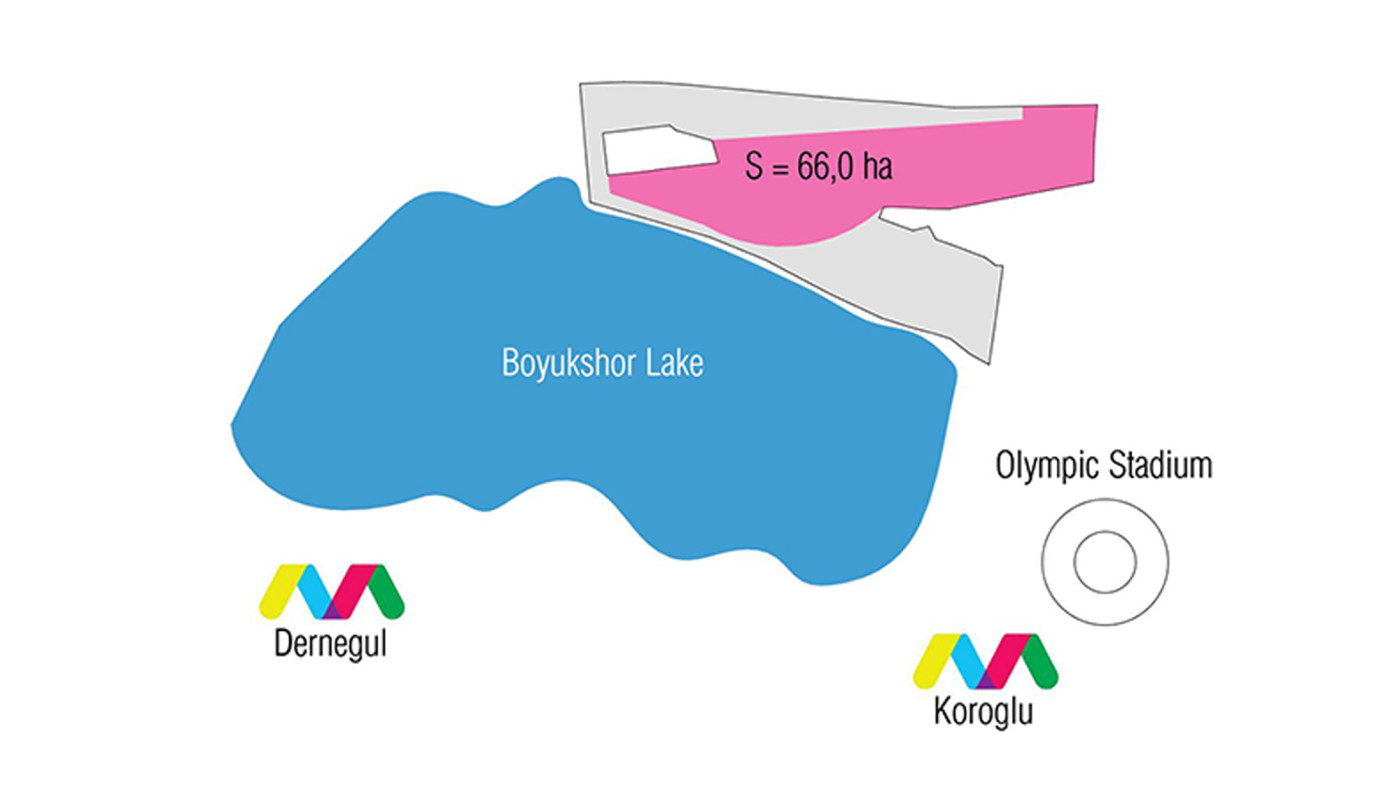
In 2013, by decision of President Ilham Aliyev, a comprehensive restoration of Boyukshor Lake and its surroundings began under a program to improve the ecological condition of nine lakes on the Absheron Peninsula. In the first phase, completed by SUEZ in 2015, 300 ha of lakefront near the Olympic Stadium were restored. The next phase was to develop 140 ha on the north side of the lake.

Location of the project site at Boyukshor Lake

The site once housed the Nobel Brothers’ oil operations
Site Research
Before starting the design, our team visited the site together with colleagues from BURØ and GA. The site turned out to be well located: just 11.5 km from the airport, 7.5 km from the Caspian Sea and 10 km from Baku’s old town. The lake lies within the city limits, close to two metro lines, major roads and the airport, and near the new Olympic Stadium, already one of the city’s symbols. The site clearly had the potential to become part of Baku, yet at the time of our visit, the land around the lake looked like a desert dotted with oil puddles.


Planning Constraints
The design takes into account the new highways bounding the site to the north and west, and a 200-meter sanitary protection zone around the oil storage tanks (the first oil storage reservoir, built in 1866).

Development Scenarios
Having analyzed the site’s potential, we focused on three development scenarios. Our studio led the amusement park, GA the R&D cluster, and BURØ the residential district.

Design exploration
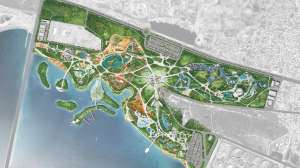
Master Plan

Key Figures and Land Use Balance

Functional Zoning

The Story of Baku Zoo’s Relocations
Baku’s first zoo was founded in 1928. Since then it has moved four times: in 1942, 1958, 1975 and 1985. In 1985, 45 hectares were allocated for its development, but only 2 were ever built. The zoo was meant to grow gradually, yet by the end of 2001 only a little over 2 more hectares had been added. At the time of our project, Baku Zoo still occupied just 4 hectares. This suited no one: the zoo needed far more space, and the city could earn more from better use of the land.
In 2008, President Ilham Aliyev ordered the zoo to be relocated so it could expand. Sites near the villages of Guzdek and Gobu were considered first; later, a site within the Jeyranbatan reserve was chosen. As of 2012, 55 hectares near Lake Gumyatag had been designated for the zoo, but that plan had not gone ahead.
Both sites are too far from Baku, which would make the zoo less attractive for spontaneous visits and harder to justify as an investment.


Zoos in the Region

The World’s Best Zoos


The Whole World in Baku
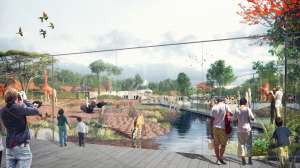
The concept for the zoo and amusement park brings together the contrasting flora and fauna of every continent on a 65-hectare site, letting visitors travel around the world for just 15 manat.

Zoo Exhibit Concept
In the 19th century, zoo animals were kept in small cages, with no regard for their natural habitat and no room to move. Visitors could only watch them from a distance.
In the 20th century, enclosures became more spacious, and zoos began to create exhibits that imitated natural habitats. Fences and metal bars gave way to glass walls and moats, and landscaping improved. One of the main changes was perimeter viewing — the principle behind most zoos of the Soviet era.
Modern zoos aim to recreate animals’ true habitats and safely immerse visitors in the wild. Animals are no longer kept in areas divided by species but share common habitats, and visitors move through them along dedicated routes, experiencing the environment in a highly realistic way.


Zoo Planting
Each zone of the zoo is planted with species typical of the corresponding continent and zoogeographic region. Together with dendrologist Sergiy Rohovskyi, we selected wind-, salt-, heat- and drought-tolerant plants that can thrive in Azerbaijan’s climate.


African savanna zone
Year-round Amusement Park with Hotel Complex

Mobility Plan

Key Buildings


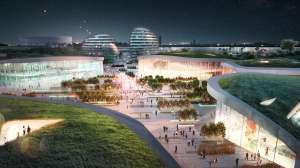
Central plaza
Site Potential
The high-tech cleanup and restoration of Boyukshor Lake showed how the land around it could be used. A modern park with a 60-hectare zoo could become a new highlight of the city, and its revenue could cover the cost of the land remediation. Woven into the urban fabric, the park could merge with the Olympic Stadium and the adjacent lakefront, so they no longer feel like places on the city’s edge.
In early 2017, Azerbaijan’s leadership decided to build the amusement park, envisioned as a new Baku landmark connected with the lakefront and the Olympic Stadium grounds.

Work in progress
Other development scenarios for the site:
KOTSIUBA Landscape Architecture
Maksym Kotsiuba, Mariia Andriienko, Marianna Kryvoruchko, Tavifa Ponomarenko, Anna Vasylieva
Architectural bureau 'BURØ'
Olena Danylenko, Sergei Ferley, Anton Gerasymovych, Lilit Akopyan, Andrii Helenyuk, Anton Oliynyk, Maria Pakhomova, Egor Shtefan, Iryna Sheptukha, Daria Voytenko, Lina Polyanska
Bureau of initiative architecture 'GA'
Vlodko Zotov, Victor Herasymenko
Independent expert
Dmytro Gurin
Dendrologist
Sergiy Rohovskyi
Layout
Daria Podoltseva