Location
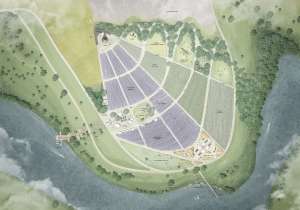
Poradiv Lavender Park lies 40 km from Kyiv, near the village of Poradivka; the site is 900 m from the village.
Poradiv Lavender Park lies 40 km from Kyiv, near the village of Poradivka; the site is 900 m from the village.

The site slopes naturally to the southeast, falling 18 meters toward the Stuhna River. To the west it borders a cornfield; on the east side, a ravine had formed and was quickly becoming overgrown with young willows.
When we joined the project, the shape of the park and the division of the site were already in place, and the first lavender had been planted.


At the time of our project, satellite images showed how sharply the river's surface area had shrunk over the previous 17 years. For the site to work fully, the water level had to be restored by repairing the weir.

The master plan placed parking along the Kyiv–Poradivka road, with a paid entrance at the start of the route to fund the park's upkeep. It also proposed electric shuttles along the existing track for visitors who prefer to ride to the field, and wooden boats on the Stuhna River.


The mood of the place is calm and tranquil. Rather than entertaining visitors, the park offers ways to spend time: kite flying, workshops, group games for children, painting, yoga, lectures and festivals.
The concept extends the lavender park's season from two or three weeks in summer to six months, from April to October. To achieve this, we added spring and fall crops and designed scenarios for the space.
Contemporary landscape art installations are placed across the park. They create a sense of place, so visitors feel they are in a park rather than in the middle of an open field.


The existing shape of the park set the direction of the paths and the placement of functional zones.
We defined five scenario spaces: a plaza, an area for workshops and exhibitions, terraces on the water, a playground and a place for quiet rest.


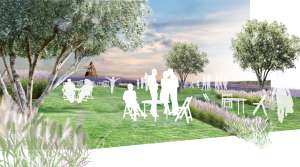
We designed the plaza as the main place for meeting and gathering, with tents selling cosmetics and local farm produce and a hay-covered lawn for conversation and light snacks.
The art space brings together artists and sculptors and can host guest lectures, yoga classes and festivals.
The terraces on the water, opposite the main entrance, face west: after a full day outdoors, visitors can gather to watch the sunset.
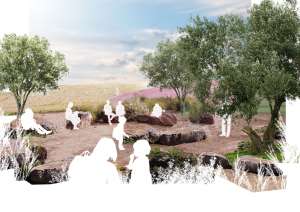
Play elements for children are made from natural local materials — logs and fallen trees — set among low-growing medicinal herbs.
Quiet areas sit within groves of Russian olive and willow that give shade in hot weather — places for evening gatherings around the fire, quiet observation of nature or jam sessions.


The plants were selected so that visitors can enjoy the park's scenery from early spring to late fall.


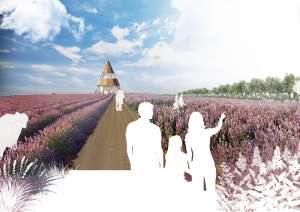
The symbol of Poradiv Lavender Park is the pyramid-shaped stepladder photographers use on shoots. At the highest point of the park, we placed an enlarged version of it: a tower visitors can climb to take in the natural terrain. The tower serves as a landmark and the park's dominant feature.

Light, changeable installations and forest sculptures made from natural, readily available materials are placed across the site.

In the first phase, the lavender planting area grew to 1 ha. The northern part was planted with young white willows and Russian olive.
A sign with the park's name, “Lavender Field,” stands at the entrance.
The park's main symbols were built: a tower on the viewing platform and an arch on the central plaza. The plaza has pavilions for selling produce and a visitor service area, with restrooms and utility rooms nearby.

Woodland planting was established along the serpentine path. The paths were extended into another section of the site, planted with fall essential-oil crops. New niches hold different functions: a wooden concert shell, a playground, a fire pit, and an area for yoga and workshops.
A changing art installation stands on the lawn of the central plaza, next to a terrace with a jetty on the water.

Spring crops were added. Medicinal herbs grow on the lawn between the concert shell and the playground, and the northern part of the field is sown with wild grasses.
A dedicated exhibition area, a sculpture on the water and installations in the northern field were added.
Poradiv Lavender Park is now an open-air venue for contemporary landscape art, with scenarios from early spring to late fall.


KOTSIUBA Landscape Architecture
Maksym Kotsiuba, Mariia Andriienko, Anna Vasylieva, Inna Dobrovolska
Lavandovyi Hai
Yuliia Bliakh
Photography
Maksym Kotsiuba